
National Terrorism Threat Assessment 2026
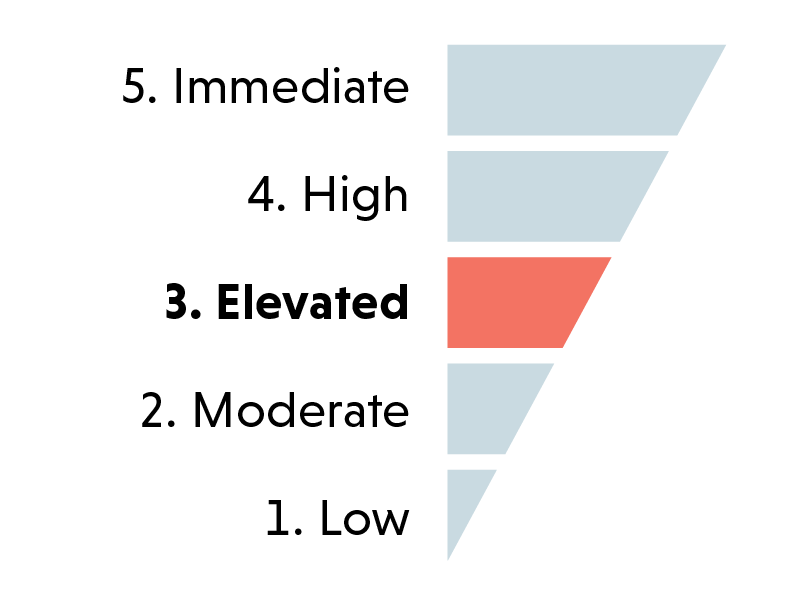
The threat level of terrorism in Finland stands at level three, elevated, on a five-point scale. The national terrorism situation is strongly linked to international trends. Terrorist attacks in Western countries are also likely to inspire such incidents in Finland.

The most likely threat of a terrorist attack comes from lone operators and small groups advocating radical Islamist or far-right ideologies. In particular, the share of young adults and minors among those participating in attack plots is increasing in Western countries. The radicalisation of children and young people mainly taking place in the online environment has been a worrying phenomenon for several years. There are numerous serious examples of young people becoming involved in the activity of extremist movements among the supporters of both radical Islamist and far-right ideologies. The general interest in violence among vulnerable young people is likely to lead to severe acts of violence.
Radical Islamist terrorism in Europe remains the principal threat
The threat of radical Islamist terrorism in Europe has remained largely at the same level as last year. The number of plotted attacks remains high compared to the years preceding the Hamas’ October 2023 attack to Israel. The war in Gaza has mobilised and radicalised individuals and networks supporting radical Islamist ideologies. The international terrorist organisations ISIL and al-Qaeda and the groups that swear allegiance to them have also sought to exploit the conflict in their propaganda and called for attacks in the West. On the other hand, their propaganda has been focusing less on acts considered to desecrate Islam.
The most likely type of attack remains a strike against civilian population using simple instruments, such as a vehicle or bladed weapon. Radical Islamist propaganda also calls for the use of firearms and explosives and instructs on how to use them. More complex attacks or attacks with a high number of casualties carried out in Western countries are likely to serve as inspiration for supporters of radical Islamist terrorism, with likelihood to generate new attack plots. However, a large-scale attack in Finland remains unlikely.
The terrorist organisations ISIL and al-Qaeda and the groups that swear allegiance to them pose the most significant global threat of terrorism. While their operations are focused on conflict areas and fragile states, they are very likely to have intentions of mounting major attacks against Western countries. As a result of counterterrorism activities, their operational capacity is limited, which is why the plotted attacks in Europe have mainly been carried out by individual radicalised lone operators or small groups.
The foreign fighter phenomenon is unlikely to significantly affect the terrorism situation in Finland in the short term. No other conflict zone has developed into anything comparable to ISIL’s ‘caliphate’ in the 2010s with power to attract significant numbers of western foreign fighters. However, individuals travelling to an area controlled by a terrorist organisation may significantly affect those in their country of origin in terms of radicalisation, calls for attacks and facilitation of travel.
Communities advocating extreme right-wing terrorism glorify earlier attacks
Online communities that support far-right terrorism continue to play a significant role when it comes to the threat of terrorist attacks. Networks posing a terrorist threat typically support accelerationism and glorify former far-right terrorists. For them, the terrorist attacks in Christchurch and Utøya some years ago with large numbers of casualties and the associated propaganda continue to play a symbolic and inspiring role. On the other hand, there have been relatively few far-right terrorist attacks in Western countries in recent years, with typically only individual casualties.
The threat of serious violence justified by extreme right-wing ideology carried out by its young supporters has increased. Minors typically have poor access to firearms and explosives, which increases the role of the use of simple instruments, such as bladed weapons. The threat is particularly targeted at people who are viewed as ideological opponents, such as representatives of ethnic, religious and sexual minorities, and political decision-makers.
Organised right-wing extremism does not pose a direct threat of terrorism, but it can serve as a platform for the radicalisation of lone operators and small groups and the planning of violent action. The capacity to engage in violent acts can be increased, for example, through combat sports training, which may involve several people who accept ideologically motivated violence.
Extreme left-wing rhetoric has sharpened
In principle, the threat of extreme left-wing and anarchist terrorism in Western countries remains low, but there are some indications of an increase in acts of violence and sabotage. In Europe, in addition to targets perceived as representing the extreme right, the targets of attacks also include critical infrastructure and large companies. In the medium term, environmental and climate issues are likely to play a growing role in far-left operations.
The Palestinian question in particular has mobilised people and networks on the far left, which has also been reflected in acts of violence in Western countries. Typically, however, they have been acts of sabotage and vandalism, done avoiding causing any casualties. The main targets have been parties considered to be linked to the Israeli armed forces and defence industry. Signs of sharpening far-left rhetoric and the mobilising effect of the Palestinian question have also been observed in Finland.
Iran and the PKK engage in terrorist activities
In recent years, several European countries have witnessed attack plots linked to Iran against targets affiliated with Israel and Judaism and the opponents of the Iranian regime. To enable deniability, criminal networks, such as groups operating in Sweden, have been typically employed for such plots. The possibility of similar activities on the Finnish soil cannot be excluded.
In Finland, the Kurdistan Workers’ Party (PKK) focuses its operations on support work, posing a low threat of a terrorist attack in Western countries. It is still unclear how the peace process initiated between the PKK and Türkiye in 2025 will affect the future of the organisation.
Acts of serious violence planned by young people have links to terrorism
General interest in violence plays an increasingly central role in the threat of violence posed especially by young people linked to extremist ideologies. The risk concerns particularly vulnerable young people for whom virtual communities associated with extremist ideologies may offer an important peer group. Radicalisation stemming from a general interest in violence is also likely to lead to severe acts of violence in the short term, such as school killings or mass shootings. Such actions do not typically pose a national security threat, but in most serious cases, may be interfaced with terrorism.
Young people’s general interest in violence is also visible in the well-publicised communities linked to nihilistic violent extremism. Groups with activities strongly focused on the online environment, such as The Com and 764, provoke people to, for example, self-destructive behaviour, sexual crimes and brutal violence. Typically, both the agitators and the victims are young, often minors. There are some similarities between their way of thinking and far-right accelerationism. The phenomenon is associated with the general interest in violence observed among young people interested in extreme ideologies. In some Western countries, online communities representing nihilistic and violent extremism have been classified as terrorist organisations.